










Remco Kouwenhoven
Impact Innovation
18 December 2020
9
min read
Share this article
Paying living wage in the electronic supply chain
For many of us, December is a time where we have to watch our wallets and budget carefully – especially this year, as COVID-19 wreaks havoc on the global economy. But for many more people, this is a year-round concern, regardless of the coronavirus.
Low wages are a persistent problem for workers in multiple sectors of the electronics industry. Many workers (and subsequently, their families) struggle to access food, education, healthcare, housing and other essentials, simply because they are not receiving a fair, living wage. A living wage is one that affords a basic but decent standard of living to the worker and their family.
Fairphone is the first electronics company that pays a living wage bonus to factory workers at our supplier Arima.
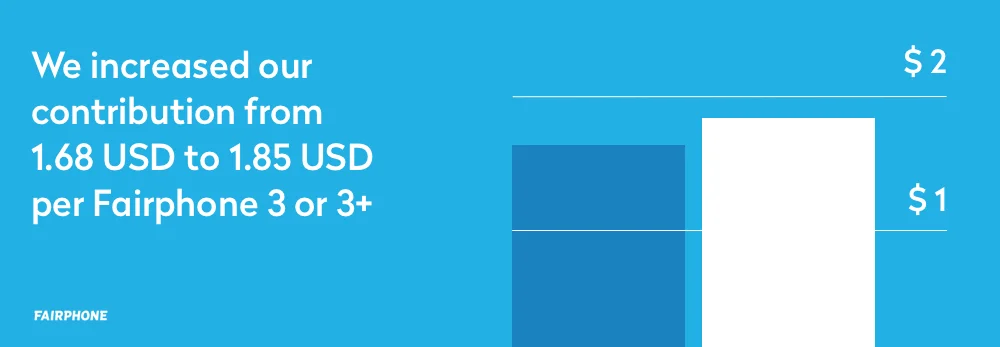
Fairphone pays factory workers a bonus of $1.85 USD per Fairphone 3 and 3+ produced. The unique system is part of Fairphone’s ongoing work to improve worker welfare in our supply chain and is paid on top of the regular salary to fill the gap between the Chinese minimum wage and a living wage.
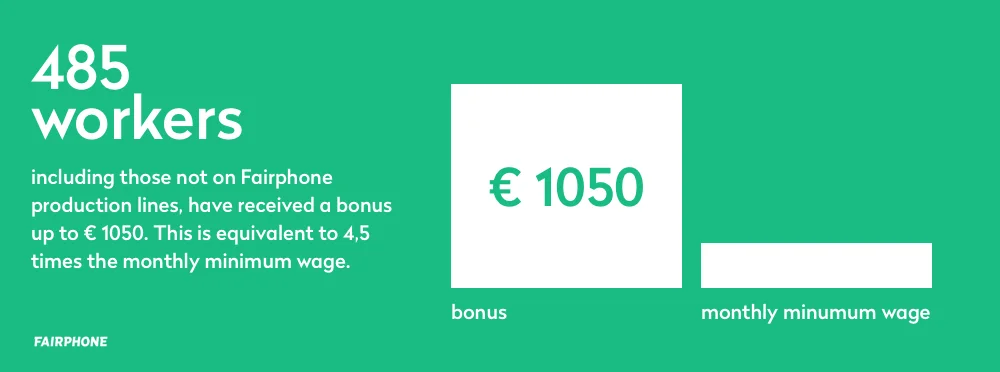
We started this in September 2019. In just over a year, more than 485 workers, including those not on Fairphone production lines, have received a bonus up to EUR1,050. This equals more than 4 months of extra salary, or in other words, a salary increase of 30% if you earn the legal minimum wage. By paying living wages we also address one of the root causes of excessive overtime, another systemic industry problem.
We’ve been regularly checking in with workers at the factory to receive their feedback on the program, and have made some practical changes in July 2020:
- We now pay out the bonus on monthly basis, rather than quarterly
- The lowest-earning workers get a higher bonus
- It’s no longer required to have worked 3 months or more at the factory to get the bonus
- Making space for regular discussion and employee surveys was key for implementing these worker-recommended changes – as is understanding the wider cultural context.
The legal minimum wage is not a living wage
With the ongoing Covid-19 pandemic, research done in collaboration with Facilitator, a Chinese NGO, found that a living wage is more important than ever, as most workers experience a loss of income, mainly due to less overtime work and lower employer revenue. During the peak of the Covid crisis in China, Fairphone has also paid the living wage bonus to some factory workers in February and March 2020 who were unable to go to the factory due to government travel restrictions – helping to support them during a challenging time.
The Facilitator research further found that the living wages in China are 2.5 to 3 times the legal minimum wage. The survey found that most workers first cut food expenses, followed by housing, medical and education expenses if their income is too low for a decent living standard. The research also confirmed a new trend. In the past, parents left their children in their home towns with their grandparents while they traveled thousands of kilometers to the factories for work. Now, more and more Chinese migrant workers move to cities along with their children and grandparents. This means that workers need an even higher income to afford the cost of living in a city with their families. To calculate the living wage for four key electronics production regions in China, Facilitator used the Anker methodology and complemented this with actual urban family size confirmed via worker surveys.
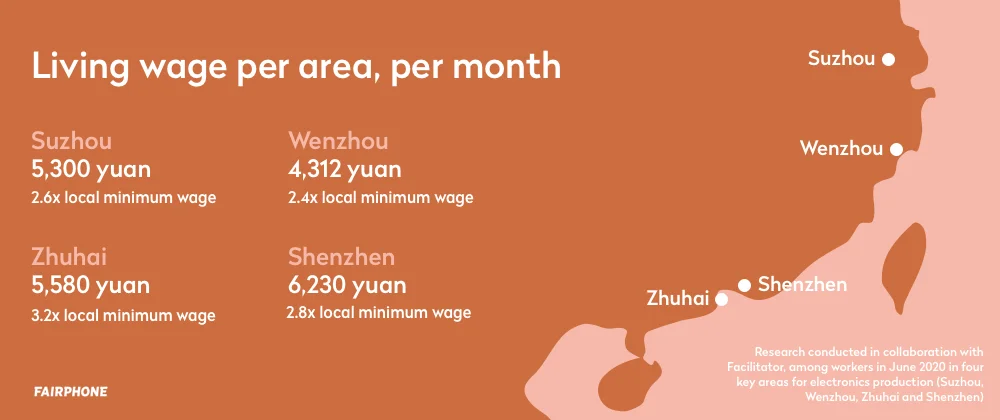
This research doesn’t just highlight the ways “business as usual” is failing workers: it provides us with valuable insight about opportunities to make our supply chain fairer.
We are proud that we have increased the living wage bonus at a time when many companies struggled to cut costs due to the global pandemic and will not be lowered when the pandemic is over. In just over a year, we have shown that it’s possible to enable living wages for factory workers in the supply chain and that costs less than 2 EURO per smartphone. The living wage program is an example of Fairphone creating a scalable model that can be easily replicated by the rest of the industry. And if they do, it could completely transform the electronics sector and the lives of the people that work in it. It’s time for electronics companies to start paying living wages in their supply chain.
To find out more about how we calculated and initially set up the living wage bonus, read our whitepaper here >>
The following content is from the article "Living wages matter. But what is a living wage?" from 01 May 2024
32-year old Mei has just gotten off her shift at a factory for one of the world’s largest smartphone manufacturer suppliers in Shanghai. She has a three-year-old who she hardly sees. Costs are increasing, while funds are always tight. That’s why Mei is still working 14 hour shifts, pulling overtime as much as she can, staying in a dormitory with others like her, hundreds of kilometers away from her family. Days off are a rarity.
“Isn’t that illegal?”
“We sign time cards that say we work 8 hours. But that is not the truth.”
“Why do it then? Why stay so far away? Why work so much overtime?”
“It is the only way I can make enough for my family and I to live. Regular hours do not pay enough.”
Mei isn’t a real person. But this fictional conversation will ring true for thousands of factory workers across electronics factories in China and Taiwan, who, like our fictional Mei, work insanely long hours under terrible conditions to earn a decent salary.
What is a living wage?
‘The remuneration received for a standard workweek by a worker in a particular place, sufficient to afford a decent standard of living for the worker and their family. Elements of a decent standard of living include food, water, housing, education, health care, transportation, clothing, and other essential needs including provision for unexpected events.’
Global Living Wage Coalition
A living wage is often not the same as the legal minimum wage. In more than 170 countries, there is a considerable disparity between the two. The sad truth is, a majority of factory workers across the world do not earn a living wage. So they have to prioritize what they spend on. Medicine and children’s education are on the top of the list, housing and food not so much. They end up living far, far away from their families, because they can’t afford the housing in the cities where the factories are located. They can’t save anything for emergencies, either. A living wage has been one of our main concerns since Fairphone started up a decade back, something we have been actively working on to help bridge the gap.
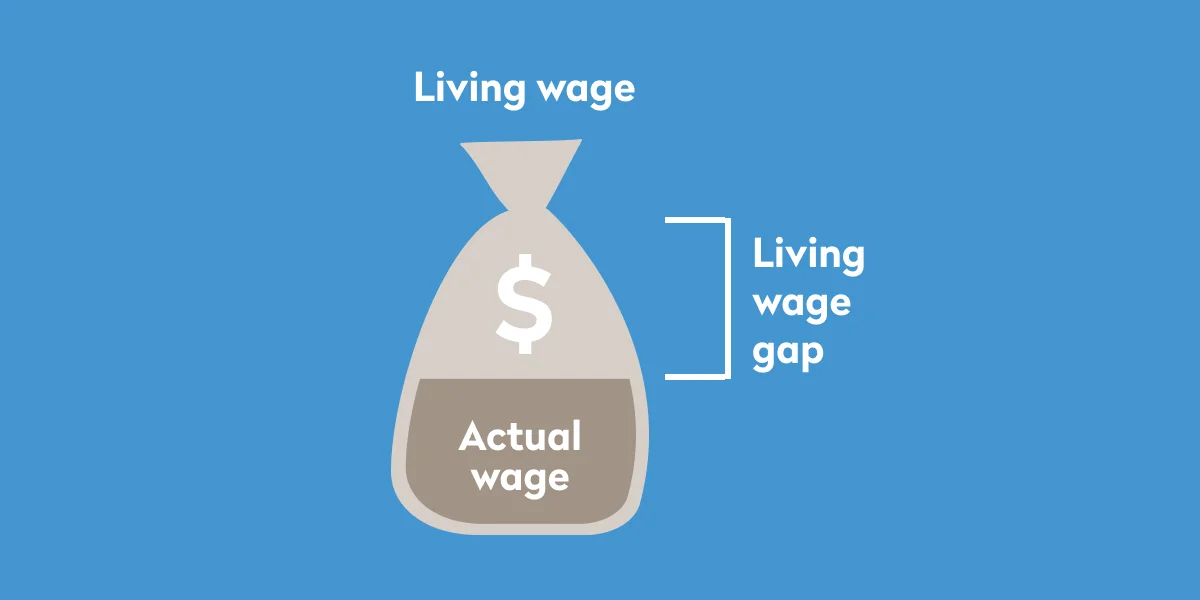
Our efforts have always been about bridging the living wage gap.
Fairphone’s Living Wage Bonus Program
In 2019, Fairphone became the first electronics company to support our direct suppliers with a living wage bonus. This is a premium paid directly to the workers, designed to bridge the gap between minimum wage and one that would afford the earner a decent standard of living. We’re also the first to pay living wage bonuses for headphone manufacturing, and to the workers of sub-suppliers of components. Since 2019, Fairphone has supported over 6,200 people working in five factories of suppliers and sub-suppliers with US$950.000 in living wage bonuses. On average, that means a month of extra salary per year for every worker we impacted.
So how does the program work? On an average, the daily wages for a factory worker is about USD $15 for an eight-hour shift with no overtime. For a living wage, workers need to earn USD $21 per day. For every hour spent on the Fairphone production line, we pay the difference, bridging the gap to a 100%. This bonus is equally divided between all low-paid workers in the factory, irrespective of whether they worked on a Fairphone product or not.
At the end of 2023, we recalculated the living wage premiums for the final assembly of our smartphones using the latest living wage estimates and production line data. The new premiums range from 23 cents for the assembly of our Fairbuds XL to USD$1.20 per smartphone assembly. This demonstrates once more how little is needed to bridge the gap to living wages.
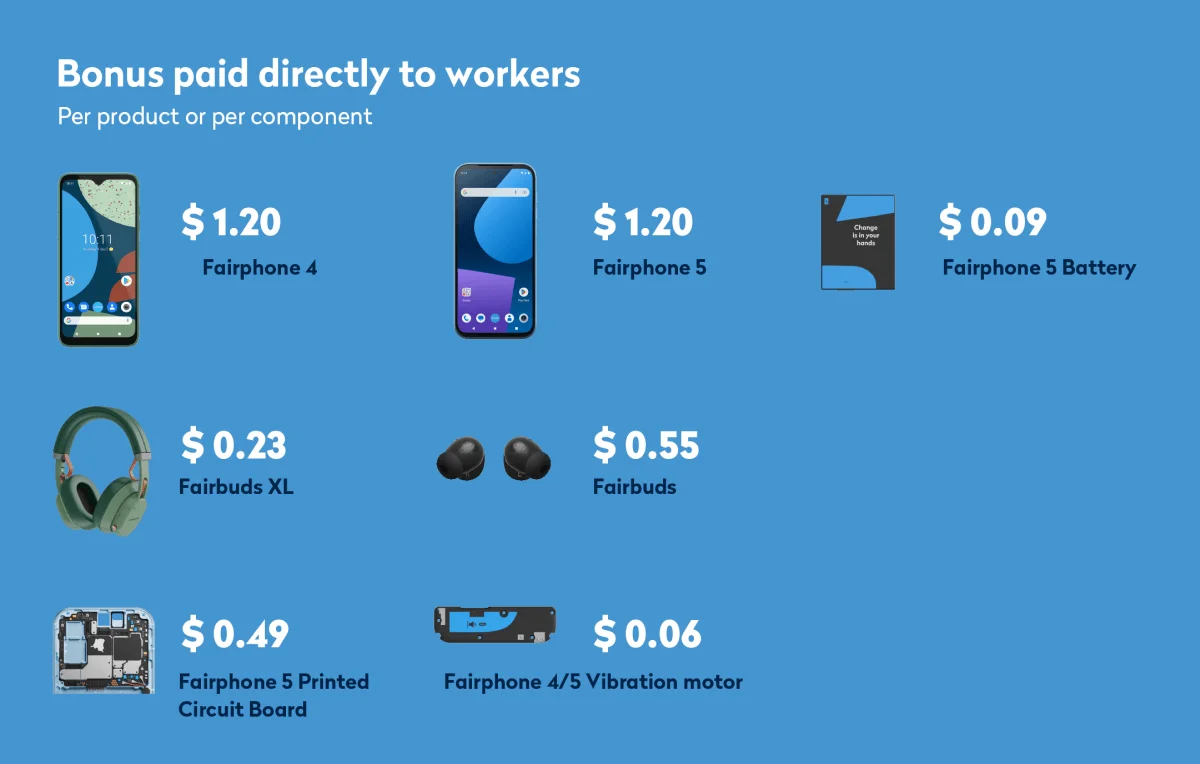
But our support doesn’t mean all workers of our suppliers earn a full living wage yet; this bonus is linked to Fairphone production, which is just a fraction of the factories’ full production capacity. Having said that, our contribution, given our size and scale, currently closes up to 15% of the total wage gap. Can you imagine if every other brand out there started doing what we’re doing?
Over the years, we have initiated a strong lobby to include the right to a living wage or income in key EU legislation and published guides for our industry peers on how to pay living wages in the supply chain. We have also been transparent about our efforts to provide a living wage to the people who make our products, via blogs, guides and tools we published on our website. We believe that by using credible data that’s been vetted by a third party, any other company can join us or follow our example. While services like this do exist, this data is usually hidden behind paywalls. Free access to credible living wage data across industries is critical to realizing living wages around the world. That’s why, as of May 2024, we are very proud to announce our role as one of the funders helping WageIndicator Foundation publish living wage estimates for 2600 regions in 165 countries. The data is freely accessible for any worker, company or union. The data can for example be used in national dialogue on the height of the legal minimum wage. Fairphone uses WageIndicator’s highest living wage estimate to calculate if there is a gap between wages paid to factory workers and living wages. This is something all companies out there who are serious about treating people fairly can actively start doing as well. At the end of the day, it is up to all companies to put their money where their mouth is and start paying living wages to the people who make their stuff.
Latest stories

Meet the changemakers: Sander de Kramer
We’re on a journey to change the electronics industry – and we’re not alone. While the Fairphone is a physical
Read more
Paying living wage in the electronic supply chain
For many of us, December is a time where we have to watch our wallets and budget carefully – especially
Read more
Turning Black Friday Green
Once upon a time – when the idea of longevity was so deeply ingrained in the collective psyche that the
Read more